Monday, February 14, 2011

The Yellow Banded Graduates

These were my feelings on the day of KAIST Graduation Ceremony 2011 i.e, 11th February, 2011 . I have managed the time to post this on my blog today. Here are my feelings for that day:

Finally, the long awaited day has arrived, the tradition of passing on the light at KAIST. The difference this time, me and my wife get two degrees of MS by Research as only Pakistanis in Computer Science in world's 21st (this year it's 24th) ranked university under Technology (simply, Asian MIT). With a lot of hopes and a mix of emotions, the yellow banded graduates head to the ceremony. This is a product of hard work of everyone associated with us (in terms of academics, advices, emotions, etc.,) and importantly a responsibility to pay back to the seed land, Pakistan. Never felt but the truth is, every single degree counts for Pakistan (part of Muslim world). Hopes went on to height as we went on to recieve something which looked impossible if life goes into flash back of more than two and a half years with no money and no sense of how to pursue higher education in ever challenging field of Computer Science. I can't mention everyone who stood at our backs in the tough times, but one person I can never forget to mention is my mother as she is the lady who turned me into what I am and led me after passing of my father when I had just passed 7 grades of basic schooling. My mother made me look to the world through her eyes and turned me into what made me a yellow banded KAISTIAN, she completed her PhD after the passing of my father and taught me by her living example before me to target higher than the known limits of the world, a lady who not only took great care of her children but also attained biggest pride in education (i.e., PhD) after passing of her life partner and my father. This by example, shaped me well and I am taking not one degree but two, one of mine and other of my wife.

Having said some of my background now comes some snaps that now become part of golden memories :)


Saturday, January 15, 2011

Do's and Don'ts: Organization of Research Talk

I have been asked this question (i.e., how to organize research talk through slides) by people from sometime and I have been replying them in private communication (i.e., over chat, emails and other means). However, now I have decided to write a blog post on this subject for greater audience.

Actually, there is no perfect answer to it but there are few tips which may be meaningful and applicable after some adjustment per area of research (it also depends upon maturity of research which is being presented).

Some tips regarding a research talk (presented by slides) with do's and don'ts are as follows.

Don'ts
  1. Never paste a flat abstract in your slides ever, because no body is ever entitled to read it like a paper during your talk.
  2. Never copy sentences, instead try to phrase it as concepts because slide is not a collection of flat sentences. It is expected to be organization of concepts, nobody would read it like a book in your talk (neither they have time nor it is expected from a talk).
  3. Never put other's content without a reference. It would be better if you put references by hinting year of publication such as BP98 or YZ10 so that viewer can understand how latest is that work. References [1], [2] etc is not helpful for talk. Remember talk is different from book or paper.
  4. Never fill too much space with content in a single slide, thats not understandable during talk (no body reads that much in one slide)
  5. Never discuss a concept to such depths that it takes more than a minute (approx.), slide is not for discussing concepts in details.
  6. Never explain a concept by talk without inserting it into your slide. People follow your talk by looking to your slides.
  7. Never use bullet or numbered list if there is no other parallel concept to that. Definition of apple is neither a bullet nor a numbered list.

Do's
  1. Always put slide numbers so that people could refer to page number later for questioning.
  2. Always put contents in terms of conceptual hierarchy.
  3. Always put two parallel concepts at same level of bullets. Apple is parallel bullet to orange if focus is fruits.
  4. Always put sub-concepts as sub-bullets as per their logical associativity. Apple may have sub-bullets such as green apple and red apple.
  5. Always use numbered lists if concepts are ordered otherwise use bullets. Algorithm is sequential flow so use numbered list.
  6. Always remember every conceptual abstraction should be completely meaningful such as overview and observation should be 100% mappable to concepts discussed inside.
  7. Always use "(1/x)" style (or similar) for concepts that expands on more than one slide, where x represents maximum number of pages till which the concept is expanded.
  8. Always put supplementary notes at the end of slides, such that if a question comes little off from slides then you can take help from supplementary slides (if needed).
  9. Always use consistent conventions such as Fig. or Figure. Consistent means, Figure and Fig. both cannot be use in complete slide.
  10. Always read your slides after preparing it completely. Take a print out and carefully examine it, you will generally find some errors in it.
  11. Always, begin your slides, by exposing the contents of your talk. Main contents should be very general: no unknown term that requires explanation could be your main heading of your contents except title of your thesis. Following is one good example.
  1. Introduction: It covers background work i.e., basic definition of objects which serves valid for your work (preliminary definitions) and then make connections among discussed objects in a story line as evolution of your focused area. Finally, link your problem statement (as natural evolution to the subject). Motivation and Goal is extremely important in this part followed by contribution of your work (which is to be explained in coming parts of your talk).
  2. Related Work: In this part, you are required to present previous related work in your area of research. You are expected to defend your idea against presented related works in later part (i.e., experimental part) in order to compare your results (i.e., effectiveness of your work). If not all then some related works are extremely important for comparing from your work.
  3. Your Work or Title borrowed from Thesis: In this part, you are expected to explain your idea and link all the concepts together as if they were pieces of puzzle fitting together. This is your part of talk i.e., fresh and new from other works.
  4. Evaluation of your work/Experimental Evidence: In this part, you are required to show the comparison of your work with other established works in order to justify your contribution.
  5. Conclusion: In last, you are supposed to summarize your findings.
Following is the link of my defense of Masters by Research (which took place on 16 Dec. 2010). You can take some help from it as sample template (i.e., how a talk could be organized)


I also wrote a post as a small talk on "writing" which may be useful for understanding the common problems while transferring ideas through writing.


Maintaining above practice for preparing slides would provide you inside worth of your own research work i.e., you can judge where you stand in terms of actual worth of your own work (approx.), therefore by preparing good slides one can always help himself or herself before anyone else. As a researcher, you are expected to be clear in transferring your ideas by speech. Making good slides is a science which must be mastered by a researcher.

If you find this post interesting please share it with your friends. By sharing it with people it will contribute either as feedbacks (correcting, adding, questioning etc.,) for me or some knowledge for other people. Always help the world, so that you could help most in return through the cycle.

Friday, January 7, 2011

Master's Thesis: Improving the Quality of Web Spam Filtering by Using Seed Refinement

I finally defended my Master's thesis titled "Improving the Quality of Web Spam Filtering by Using Seed Refinement"on 16th December, 2010. The thesis deals with a significant problem from the viewpoint of today's World Wide Web namely Web spam which has become a nuisance for search engines today.

The thesis proposes seed refinement techniques for four well-known web spam filtering algorithms: TrustRank, Anti-TrustRank, Spam Mass, and Link Farm Spam. The input seed is refined by maintaining an exception list in the input seed set. This proves to be helpful in decreasing false positives while increasing true positives. Additionally, in this thesis, a strategy for the succession of the modified algorithms is also proposed. These are classified into two classes: a seed refiner followed by a spam detector. Modified TrustRank (MTR) and Modified Anti-TrustRank (MATR) which are seed refiners while Modified Spam Mass (MSM) and Modified Link Farm Spam (MLFS) which are spam detectors.

Following is my Master's thesis defense presentation which I am sharing for those interested:


The full-text of the thesis can be downloaded from here or here (the journal copy). Interested students/researchers may contact me for any questions, comments and feedback. The full-text of the thesis can also be requested via email.

For Citation:
@article{qureshi2011,
  title={Improving the Quality of Web Spam Filtering by Using Seed Refinement},
  author={Qureshi, Muhammad Atif; Yun, Tae-Seob; Lee, Jeong-Hoon; Whang, Kyu-Young},
  journal={Journal of the Institute of Electronics Engineers of Korea},
  volume={48},
  number={6},
  pages={123-139},
  year={2011}
}

Monday, November 22, 2010

Why Writing is Important?

Do I need to learn how to write? What does it mean? Does it only mean I should write correctly in terms of grammar? The answer for 'only grammar' is No.

Lets go to the fundamentals, why do we write? Um... one would say, for communication. Then why do we communicate? For making others understand our viewpoint. So understanding is the most important concept.

Now, whats special with writing provided that we can talk too? The key idea is preservation of clear thoughts and that's the magic of writing. Its not important to write in perfect grammar as compared to writing clear and unambiguous(which are interpretable in one way) thoughts. Grammar is a side hero in this area but the main hero is transfer of clear thoughts.
In this article, I took grammar as a general representative of syntax (i.e., spellings, tenses etc). Some people feel that writing is about bragging their fluency in a particular language but this is one common myth.

Let me give some examples of unambiguous writing so that I can transfer my thought in a clearer way.
1- This is a sentence where a/b is true.
Ans- How do I read that? This is a sentence where a or b or both are true. Common mistake in the interpretation could be a or b (at the reader’s end or at the writer’s end or at both ends).
2- This is example: This supports the example strongly.
Ans- How do I read that? This is example and following sentence strongly supports it due to colon. Common mistake would to ignore ‘:’ by reader/writer.
3- I am writing; I am sharing myself.
Ans- How do I read that? I am writing and one reason is to share myself. Common mistake could be to ignore ‘;’ or make it strongly associated with previous sentence by reader/writer i.e., I am writing because I want to share myself.

To conclude my short post, writing is a very effective way of communication. However, it brings complications because it does not involve body language (as we have in talks). Therefore, its important to understand the idea behind this style of communication in order to avoid being mis-reported or mis-read etc. It is also an important skill for both readers and writers.

If you find this post interesting please share it with your friends. This post is both applicable for general and technical writing purposes/practices.

Tuesday, September 14, 2010

Steps of utilization of human mind

Following are general steps defining the utilization of human mind in an activity.
  1. Question your surrounding
  2. Question beyond your surrounding
  3. Think for what to adopt
  4. Maximize following of adoption
If required go back to previous steps.

People may apply this to maximize anything which interests or affects them, be it education and research, paid professional research, business need, scientific advancement and religious/non-religious thinking. While the activities which do not involve above general steps fall into norms, culture and control. If an activity expects utilization of mind but above mentioned steps are not followed then the person is in illusion. Questioning always breaks illusion and borrowed questions may introduce stronger illusion; if questions are borrowed then expansion through step 2 should not be borrowed to full in order to keep it reasonably natural. A point to note here, thinking is natural but illusion is sleeping drug to our human mind.

Friday, September 3, 2010

[Paper]: Blogosphere Topic Clustering and Ranking


The paper deals with the Identification and Ranking of Topic Clusters in the blogosphere. Topic clusters represent in this paper the concept of grouping together blogs sharing a common interest i.e. topic. The algorithm takes into account both the hyperlinked social network of blogs along with the content in the blog posts. Topic-specific ranks are assigned to each blog in the cluster using a metric called “Topic Discussion Rank,” that helps in identifying the most influential blog for a specific topic. Experiments show that the presented method reaches a high level of accuracy.

This method proposed suggests a hybrid approach: first, content words of the blog posts are used to determine the relevance of a blog for a given concept, and thus the assignment to a "cluster". Second the links originating from the blog are used to rank the relevance of the blogs within the "cluster".

In the age of Web 2.0 the blogosphere has assumed a very significant role and it serves as an opinion dissemination medium; as such this research is part of a long-term project on blogosphere research and we would like to invite students/researchers who are interested in this area to collaborate with us. I recommend such people to contact me through email at atifms@kaist.ac.kr or matifq@yahoo.com; or they can contact my colleague at arjumandms@kaist.ac.kr or arjumand_younus@yahoo.com.

The full text of the paper can be downloaded from this link: paper.

Additionally a discussion on the workshop: collaboratively constructed semantic resources can be found here and your comments are also welcome.

Tuesday, August 31, 2010

Visit to Microsoft Research Asia: Details on Discussion

27th August, 2010 was a memorable day for me as me and my colleague who also happens to be my wife had a tour of Microsoft Research Asia in Beijing, China.

Mr. Yunbo Cao who works there hosted the two of us. He was an extremely humble guy and his humility and kindness was evident through the session. First we were shown around the research labs and work area; he showed us how for every employee at Microsoft Research instead of having name plates outside each employee's office they have written name of city to which that employee belongs.


Microsoft Research Asia is Microsoft’s fundamental research arm in the Asia Pacific region and it was founded on November 5, 1998. In 2004, MIT Technology Review named Microsoft Research Asia “the hottest computer lab in the world.” From Microsoft Research Asia have emerged many technologies that have had a huge impact on the technological community today. Over 200 innovations from the lab have been transferred to Microsoft products, including Office XP, Office System 2003, Windows XP, Windows Server 2003, Windows XP Media Center Edition, Windows XP Tablet PC Edition, Xbox, MSN, Windows Live. In addition, technologies from the lab have been adopted by international standards bodies such as MPEG4 (error-resilient video transmission), IETF (TCP/IP header compression), and ITU/ISO (video-compression technology).


The prominent labs at Microsoft Research Asia which Mr. Yunbo talked about are:
  • Web Search and Mining: the goal of this group is is to drive the next generation of Web search by leveraging data mining, machine learning, and knowledge discovery techniques for information analysis, organization, retrieval, and visualization. Its core areas focus on structuralizing the Web, vertical search, large-scale experimental web search platform, mobile search and multimedia search.
  • Information Retrieval and Mining: the goal of this group is to develop advanced technologies to help users accurately, quickly, and easily find information. Currently, the group is working on three projects: algorithms for improving web search, enterprise search, and community search. The following research areas are being intensively investigated: search relevance and learning to rank, link analysis and web graph mining, anti-spam and adversarial information retrieval, document information extraction, and search log data mining.
  • Natural Language Computing: this group is focusing its efforts on a variety of research topics, including multi-language text analysis, machine translation, cross language information retrieval, and question answering. Over the years, the group has made significant contributions to Microsoft products, including a Japanese and Chinese Input Method Editor (IME), English writing assistant for Office 2007, Chinese couplet game for Windows Live, Chinese word breaker, pinyin search
  • Web Intelligence: the aim of this group is to enable synergetic collaboration between people and between people and computers to enlighten them and enrich their lives. For this mission researchers of this group develop scalable automatic content analysis methods and quality metrics to analyze a huge amount of online text such as blogs, community-based question answering, forum discussions, news, reviews, Twitter, Wikipedia, etc. and to harvest explicit and implicit knowledge from these media.
Mr. Yunbo himself is part of Web Intelligence group and prior to this he was a part of the Natural Language Computing group. The areas of focus of his group are expert and social search, user intent/activity recognition and prediction, inarticulate user assistance, information access evaluation, social question answering and summarization and sentiment analysis. His research work heavily centers around community-based question answering services.

He told us that the third and fourth floor of Microsoft Reseach Asia is called the Microsoft Search Technology Center and the main focus of all research there is the newly released search engine by Microsoft Bing - this year's SIGIR had 15 papers by Microsoft Research and one can see that researchers at Microsoft are pushing hard day and night to make Bing better and better.


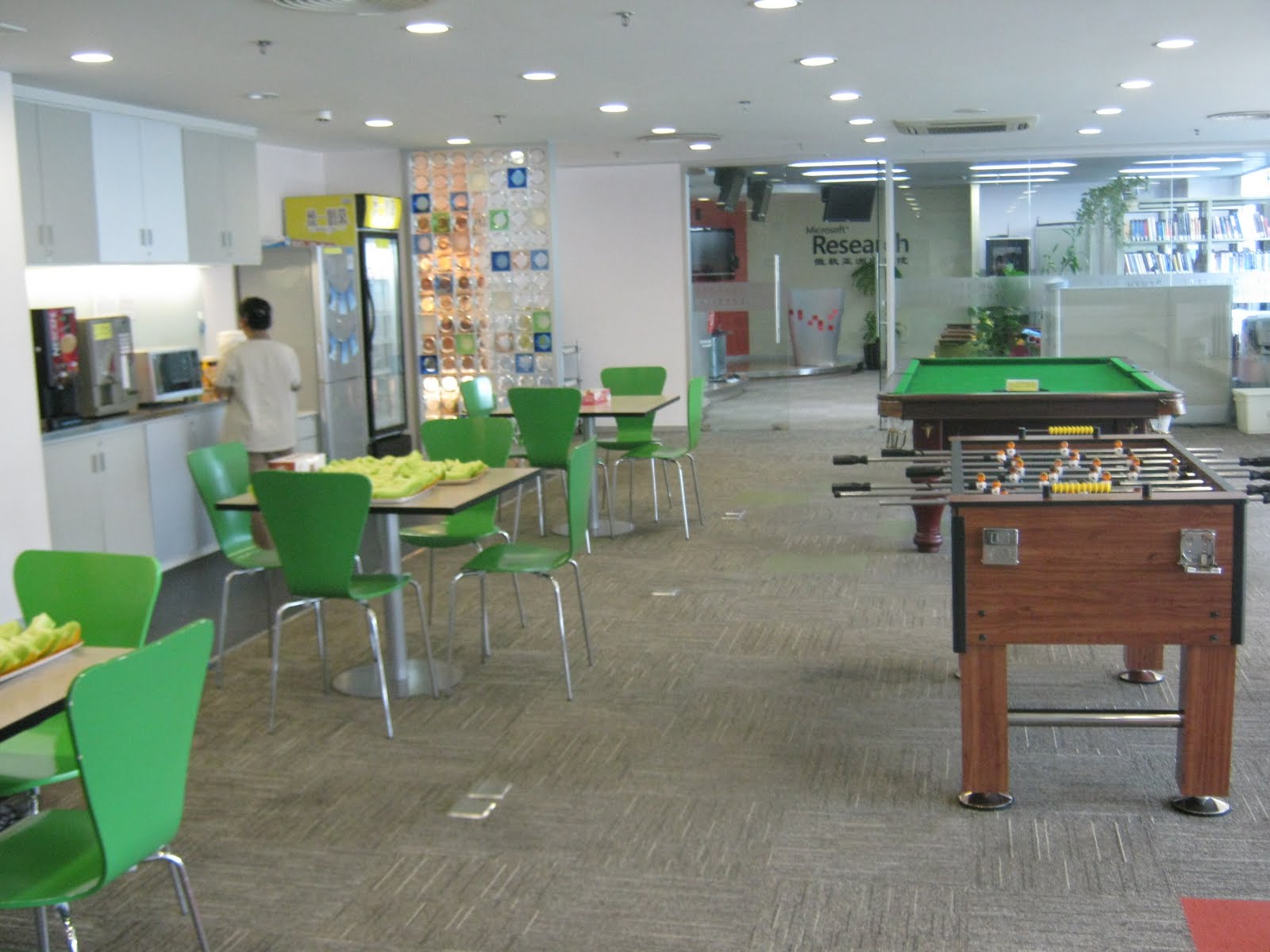
We could not take photographs of the labs as it was not allowed but it was allowed for some places and the picture below shows the Microsoft Research Asia recreation area where the employees enjoy some time off from work, when we reached it was fruit time. Mr. Yunbo offered us some but we could not take any as we were fasting.


The discussion then moved towards our research focus at Database and Mutlimedia lab of KAIST. We told him about a state-of-the-art project by our Professor which relates closely to search engines - the paper got best demonstration award in ICDE 2005. I further explained him how my Professor considers it as an offense to the traditional databases if researchers worldwide believe that MapReduce based systems are the answer for massively scaled information retrieval tasks. The research idea is to incorporate an information retrieval architecture into existing parallel databases to provide best of both worlds: the scalability of Map-Reduce based systems and the additional functionalities of databases (SQL, schemas etc.). These ideas were appreciated by the Microsoft researcher. I told him about my thesis problem statement on improving quality of web search results by combating spam and my wife told her about her work on scalable, massive architectures for parallel web crawling; he was surprised at hearing that we were the only ones in our lab working on these huge project modules and said that at Microsoft they are working in groups for even at module level (for Bing project). We exchanged some information regarding system's nature from being static search to dynamic search.

Then we raised the point for final part of our talk centering around academic collaborations between Pakistani universities and Microsoft Research Asia and future plans of Microsoft Research Asia towards Pakistan. Mr. Yunbo said that Microsoft Research Asia has many, many collaborations with universities through out Asia and that Microsoft Research has two research centers in Asia, i.e., in China and India but China heads Asia in whole as its Microsoft Research Asia. He added that Microsoft Research Asia is always looking for more and more engineers. I asked about the reason behind presence of academic/research collaborations in universities through out Asia but an absence in Pakistan; to this question Mr. Yunbo replied that Microsoft has some collaborations with Pakistani universities but he agreed that those were only technology-oriented collaborations and none exist on applied research and academic level. Additionally he pointed out that Microsoft Research Asia would love to have academic/research collaborations with Pakistani universities and till now there is no serious thought due to lack of an appropriate channel through which to initiate such collaborations. He added that student-researchers like us can serve as the bridge between Pakistani universities and Microsoft Research Asia; and he suggested us to contact Microsoft Research University Relations Team. Mr. Yunbo believes that both Pakistani universities and Microsoft Research can greatly benefit from such academic collaborations and it can lead to a whole new opening for researchers in Asia, as intelligence can never be confined inside some regions only.

On our way in a passage, he showed us souvenirs that were given to Microsoft Research Asia by different universities of Asia but Chinese presence was much dominant in those proving how open Microsoft Research Asia is in visiting different universities.

Readers are advised to drop in their comments, questions, suggestions as we intend to carry these plans forward for promoting and improving Computer Science research in Pakistan.